How SOPs Turn Agent Demos into Repeatable Work
A customer-support team has years of conversations but no usable playbook for its AI agent. Channel Talk describes turning those conversations into draft rules, reference documents, and tasks for ALF.[1]
A quick look at Channel Talk and ALF
Channel Talk is a customer-support platform: visitors can contact a business through a chat widget, and the team handles conversations in a shared workspace. ALF is its AI support agent. It can use the business's configured knowledge to answer questions and run enabled Tasks, such as looking up an order.[2][3]
The official Korean-language video below introduces ALF v2 with product demonstrations. It helps put the support conversation and the agent's work in context; the interface may have changed since the recording.
Official ALF v2 introduction and product demonstrations; Channel Talk, Korean audio. Watch on YouTube · Official source
To connect the interface to the SOP case, distinguish three things the business configures:
- Rules: instructions for how ALF should behave.
- Knowledge: material it can consult when answering.
- Tasks: configured actions that connect the conversation to work such as an order lookup.
The pipeline below prepares drafts for those three configuration areas.[1][3]
Channel Talk: turn existing work into a procedure
Channel Talk uses an Agent SOP to guide this analysis pipeline. The customer-support SOPs it produces become draft material for ALF configuration. Scripts supply real conversation samples before model interpretation; people review the resulting settings before use.[1]
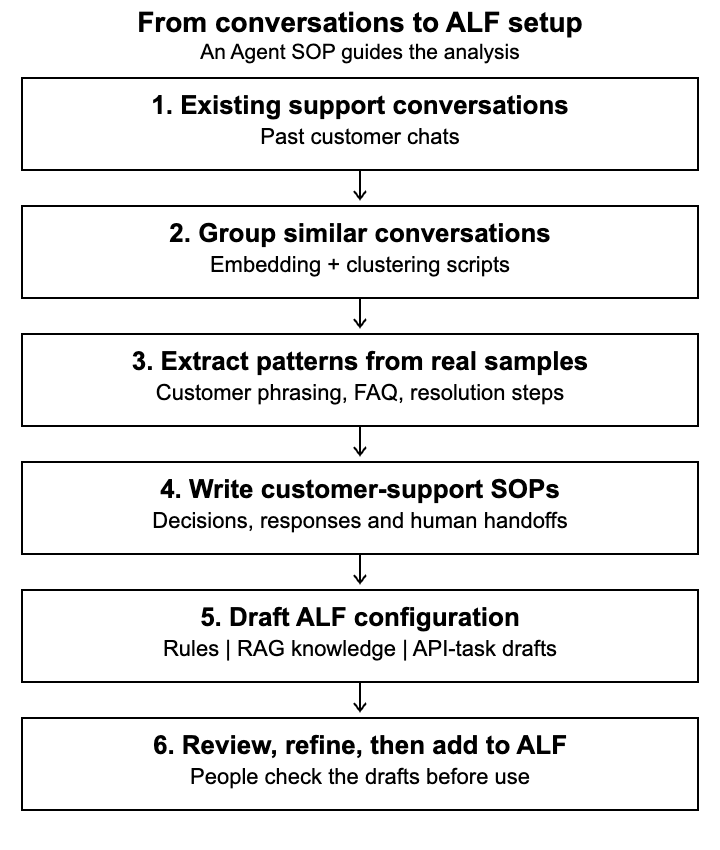
Author's summary of Channel Talk's process; based on Pete (April 2026).[1] Full-size diagram
Example: 'Where is my order?'
Here is an illustrative walkthrough of the six steps, rather than a customer deployment reported by Channel Talk.
- Start with conversations. Imagine past chats containing 'My order has not arrived' and 'Can you check my delivery?'
- Group the topic. Put these enquiries into a delivery-status group, separate from requests to cancel an order.
- Extract the handling pattern. Read the actual exchanges: the operator asks for an order reference, checks shipment status, then explains the next step.
- Write the support SOP. For a delivery-status request, obtain the order reference and look up the shipment. Explain the recorded status using the business's approved guidance. If the lookup fails or the case needs a person's judgment, hand it to support.
- Prepare three configuration drafts. A rule tells ALF when to use this procedure; a knowledge document supplies approved delivery guidance; a task draft describes the order-status lookup API and its inputs.
- Review before use. The team checks the policy and API mapping, tests missing references and failed lookups, then refines the drafts before adding them to ALF.
From the customer's side, the exchange could look like this:
Customer: 'My order has not arrived.'
ALF: 'What is your order reference?'
Customer: 'ORD-123.'
After a successful lookup, ALF: 'The carrier status is [status returned by the lookup]. [Next step from the approved delivery guidance.]'
The brackets are placeholders for verified information. The procedure gives ALF a way to obtain an answer; it does not supply a guessed delivery date.
What happened when an agent got a detailed SOP?
A library assistant can renew a book and still fail its job. It might skip the eligibility check, use the wrong account identifier, or forget to send confirmation. Getting the tool call to succeed is only part of the work.
In a March 2026 Strands experiment, replacing simple instructions with a detailed standard operating procedure (SOP) raised the evaluation pass rate from 82.5% to 99.8%. The study used six scenarios, each repeated 100 times per approach. Its checks covered procedure adherence, tool use, and tone.[4]
| Approach | Reported pass rate | Average input tokens |
|---|---|---|
| Simple instructions | 82.5% | 2,329 |
| Detailed SOP | 99.8% | 9,879 |
| Steering hooks plus gateway policy | 100.0% | 3,346 |
| Graph-based workflow | 80.8% | 3,116 |
These are results from one controlled example, not a ranking of architectures. Six repeated scenarios do not represent every production request. The stronger steering configuration also used policy enforcement; the comparison does not isolate hooks alone.[4][5]
The production question: can it finish the customer's job?
Gradient Labs offers a more operational example. In an Anthropic customer story, the company reports 80–90% end-to-end resolution without human intervention for financial-services customer support. Its platform uses Claude to interpret requests, determine the next SOP step, and use relevant tools within a knowledge-graph-based system.[6]
This is a vendor-published customer account. The page does not disclose a complete evaluation dataset, observation window, or a controlled comparison with SOPs removed. Its resolution rate is also a different measure from the Strands experiment's pass rate. It shows a deployed use of procedural agents; it does not establish that an SOP document alone produces that result.
For a developer, the useful connection is the unit of work. The system is expected to carry an issue through its required checks and actions. A plausible answer is insufficient when the customer needs an account updated or a request escalated.
What an SOP actually adds
SOP usually expands to standard operating procedure: a repeatable method for carrying out a defined task. It records the sequence, decisions, and constraints that experienced operators otherwise carry in their heads.[7]
For an agent, a useful procedure answers five questions:
- When does it apply? Identify the request or trigger, including requests it must leave alone.
- What must be known first? Name the required inputs and authoritative sources.
- What comes next? Specify tool calls, branches, and dependencies.
- When must it stop? Define failure handling, escalation, and actions that require a person.
- What proves completion? State the observable result and evidence to retain.
This is a practical authoring checklist, rather than a universal SOP standard. Strands provides one concrete format: Markdown with an overview, parameters, ordered steps, and constraints expressed with words such as MUST and SHOULD. It can be distributed through agent skills, MCP, or direct integration.[8]
A skill packages a procedure so an agent can find and use it. A workflow engine can control transitions. A tool policy can reject an action. Those mechanisms can support the same SOP while providing different kinds of control.
Open the document: where does reliability come from?
The Strands sample makes the difference visible. Its SOP specifies checking a book's status with a named tool before renewal. It also specifies that the library card number must come from the user-info tool, rather than from the customer's message.[9]
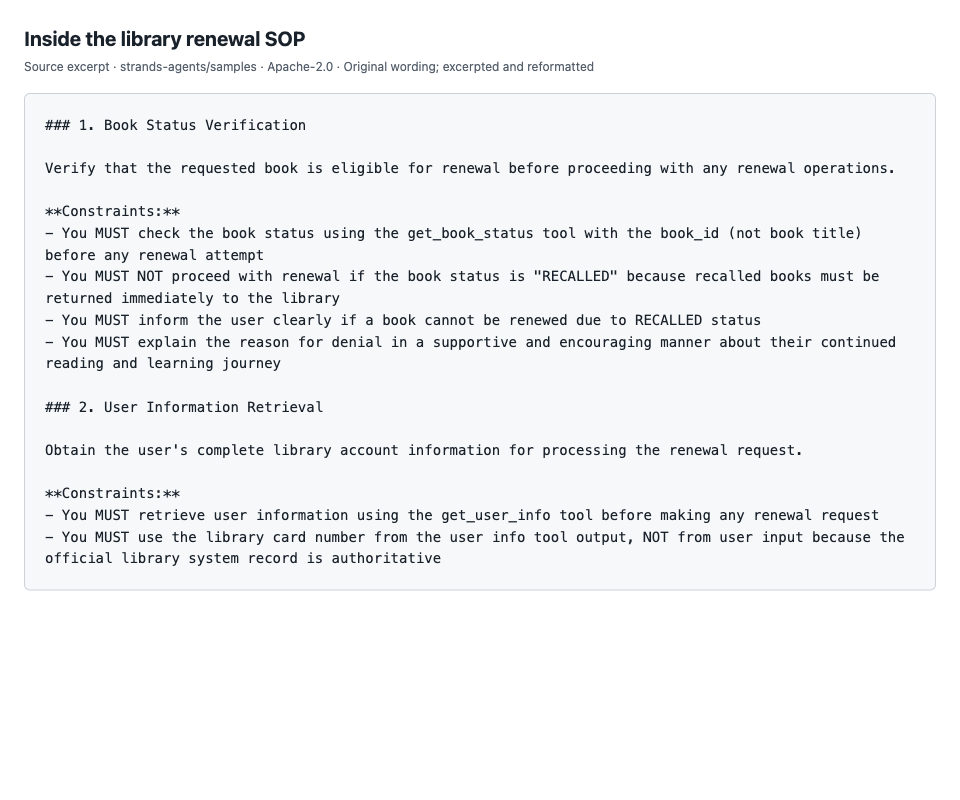
Required checks in the Strands library SOP; source excerpt, Apache-2.0, reformatted. Source · License
'Check eligibility' leaves room for interpretation. Naming the tool, the identifier it accepts, and the condition that prevents renewal makes the expected action inspectable. The sample also separates a request to renew from a request that merely asks which books are checked out.[9]
In the sample implementation, the SOP is loaded into the system prompt. It remains guidance interpreted by a model. The separate steering configuration checks behavior around execution and uses a gateway policy for the renewal-period limit.[5][10]
That distinction matters when choosing an implementation. A written MUST states the requirement. A check at the tool boundary can prevent a prohibited call from executing, provided the action passes through that boundary.
Three ways to make procedures executable
| Method | What carries the procedure | Useful when | Main limitation |
|---|---|---|---|
| SOP in the agent's context | Natural-language steps and constraints | You use an existing assistant and want a repeatable task method | The model can still skip or misinterpret instructions |
| Procedure compiled into workflow logic | Structured transitions and integrations | A business process needs controlled branches and actions | Branches and exceptions need maintenance |
| SOP with runtime checks | Instructions plus checks around tools and outputs | Specific rules must be checked before execution | Coverage and state handling become engineering work |
The first and third patterns are illustrated by the Strands sample. Decagon describes the second through its Agent Operating Procedures: business teams write natural-language instructions that compile into structured workflows, while engineers manage integrations and guardrails. That is the vendor's documented architecture, not an independently verified accuracy guarantee.[5][11]
These are choices about where to put control. A rigid path may suit a stable sequence, while a procedure interpreted by an agent can accommodate more variation. In either case, explicitly handle requests that fall outside the procedure.
Start with one workflow you can judge
For someone already using a coding agent, a small bug-fix procedure is a useful starting point. Here is an illustrative SOP, not a tested automation:
Scope: A requested bug fix in an existing repository.

1. Read repository guidance and the reported behavior.
2. Reproduce the failure, or record why reproduction is blocked.
3. Identify the relevant code and an observable acceptance condition.
4. Make the smallest change that addresses the cause.
5. Run the relevant checks and retain their actual results.
6. Review the final diff against the request.
7. Report the change, evidence, and unresolved limitations.

Stop conditions:
- Missing requirements that determine the behavior: ask for clarification.
- Uncertain external write: inspect state before considering another attempt.
- Failed checks: report failure; do not label the task verified.

Completion evidence:
- Reviewed diff or commit identifier.
- Check results tied to that code state.
- Any remaining verification gaps.
The important authoring exercise is to replace vague verbs. What counts as 'verified'? Which checks are relevant? What state identifies the code that passed? Answer those for your repository before expecting the procedure to transfer reliably.
AWS reports that Amazon teams use thousands of Agent SOPs for work including code review, documentation, incident response, and monitoring. This is evidence of internal adoption, not a published accuracy measurement across those workflows.[12]
Channel Talk again: test the conversation, then review the fix
A separate June 2026 Channel Talk engineering post describes automated QA for tasks such as order lookup and returns. It derives scenarios from graph paths, uses an LLM to simulate users, and injects expected API results instead of making real business calls. This makes the cases repeatable without actually submitting returns.[13]
Matching the visited path to an expected endpoint was insufficient: an agent could reach it after giving poor answers. The team added intent-based evaluation of the conversation, then an agent that proposes task improvements from failures.
The author reports an improvement in resolution qualitatively, without a numerical before/after score. At publication, the improvement loop was a PoC and people reviewed proposed changes before applying them. Its value here is the concrete testing method and human review boundary.[13]
Measure the finished work and the path taken
Broader evidence tempers the library result. SOP-Bench v2 contains over 2,000 tasks across 12 business domains, with executable tools and human-validated answers. It finds substantial variation across procedures and model–agent combinations. Its purpose is to make those differences testable, rather than to demonstrate one universally reliable agent.[14]
The benchmark distinguishes execution completion from correctness among completed tasks and overall task success. That prevents 'the agent said it finished' from becoming the success criterion. Its 2026 research summary also reports that adding plausible but unnecessary tools reduced success on a tested procedure.[14][7]
For your own workflow, I would evaluate four things separately:
- Outcome: did the requested state actually change correctly?
- Procedure: were prerequisite checks and required handoffs performed?
- Restraint: did the agent avoid actions the user had not requested?
- Cost: how much latency, model usage, retrying, and human review did success require?
Include normal cases, missing information, invalid inputs, tool failures, and requests that should not trigger the workflow. Repeat cases to expose variation, while keeping unseen cases for a separate check. Strands' Eval SOP provides a practical sequence for organizing that work: planning, test-data generation, execution, and reporting.[15]
The library experiment shows that explicit procedure can make a substantial difference within a defined task. The production case shows why complete resolution matters. To apply either lesson, choose one recurring job and write down the checks, decisions, and evidence that make its completion trustworthy. Then test whether the agent actually follows them.
References
- Pete, Channel Talk. Extracting manuals from customer-support data (Korean: 상담 데이터 분석을 통해 메뉴얼 추출하기). April 23, 2026. Analysis-agent SOP, generated support SOPs, reviewable ALF configuration drafts.
- Channel Talk. Getting started. Customer-facing chat and team support workspace; accessed November 5, 2026.
- Channel Talk. What is an AI chatbot? (Korean). February 5, 2026. ALF knowledge and Tasks; official embedded ALF v2 video.
- Clare Liguori. How Steering Hooks Achieved 100% Agent Accuracy Where Prompts and Workflows Failed. March 18, 2026. Evaluation results; six scenarios; token table.
- Strands Agents. Library Book Renewal Agent README. Agent versions, evaluators, policy-gateway differences; pinned source.
- Anthropic. Gradient Labs transforms financial services customer support with Claude. SOP execution and reported end-to-end resolution. Vendor-published customer story.
- Rohith Nama and Subhrangshu Nandi. SOP-Bench: A new benchmark for evaluating AI agents on real business procedures. August 21, 2026. SOP definition, procedure variation, tool-registry experiment.
- Strands Agents. Agent SOP format. Overview, parameters, constraints, distribution. Living documentation; accessed November 5, 2026.
- Strands Agents. Library book renewal SOP. Applicability; steps 1–2; confirmation requirements.
- Strands Agents. SOP agent implementation. Loading SOP content into the system prompt.
- Decagon. Agent Operating Procedures: From Manual SOPs to Automated AI Logic. November 26, 2025. Natural-language procedures compiled into workflows; business/engineering responsibilities.
- James Hood and Nicholas Clegg. Introducing Strands Agent SOPs. November 20, 2025. Internal Amazon adoption and use cases.
- Mango, Channel Talk. Building an automated task-QA and improvement agent (Korean: 팀장님이 QA 100번 시키길래 만들었습니다.). June 11, 2026. Graph scenarios, simulated users, API mocks, intent evaluation; human-reviewed PoC.
- Subhrangshu Nandi et al. SOP-Bench: Complex Industrial SOPs for Evaluating LLM Agents, v2. February 23, 2026. §4.1 evaluation metrics; §5 results and ablations.
- Strands Agents. Evaluate with AI. Four evaluation phases; living documentation, accessed November 5, 2026.